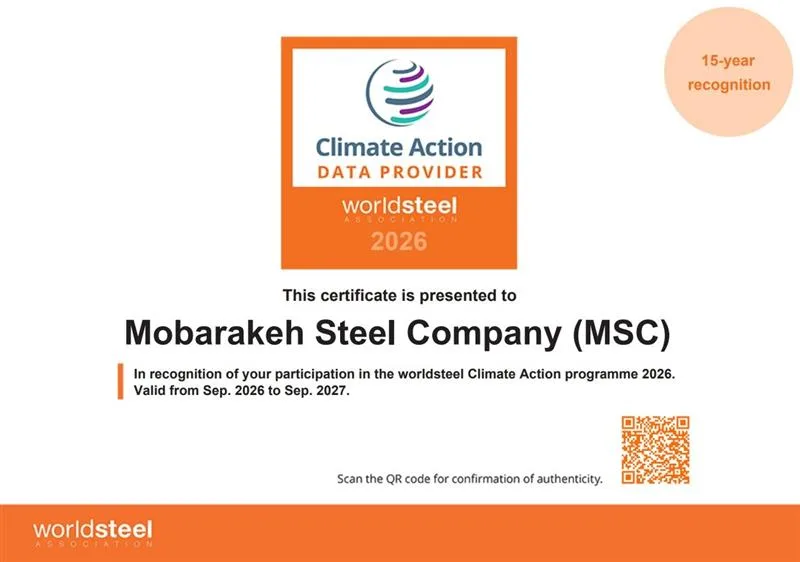
As the global steel industry moves toward greater transparency across the value chain, Mobarakeh Steel has leveraged its long-standing collaboration with the World Steel Association and its alignment with the updated 2024 methodology to pave the way for more accurate management of greenhouse gas emissions.
According to the Communications Management of Mobarakeh Steel Group, Mobarakeh Steel, with more than 15 years of continuous participation in the World Steel Association’s Climate Action Programme (worldsteel), is considered one of the long-established companies in monitoring and reporting CO₂ emissions in the global steel industry.
The World Steel Association’s Climate Action Programme provides site-level and company-level emissions intensity indicators, enabling the performance of steel companies in managing carbon and greenhouse gas emissions to be assessed and compared with the global average. The systematic collection of emissions data is one of the key requirements for understanding the current situation and planning emission reductions as the steel industry moves toward decarbonization.
More Than 15 Years of Continuous Data Collection
The World Steel Association’s CO₂ data collection programme was launched in 2008 to establish an integrated framework for collecting, assessing and comparing greenhouse gas emissions data across the steel industry.
More than 200 companies participate in the programme’s data collection process annually. Over the past 15 years, Mobarakeh Steel has also consistently submitted its emissions data and, following verification, has received certificates of participation.
The continuation of this process has provided Mobarakeh Steel with a historical dataset that can be used to examine trends in emissions intensity, assess the effects of energy efficiency measures and identify areas for improvement. This historical data record is considered one of the key foundations for evidence-based decision-making and planning in the field of carbon emission reduction.
Methodology Updated in 2024
The methodology used in this programme is based on ISO 14404 and takes into account differences in production processes and reporting boundaries when calculating and comparing CO₂ emissions intensity in iron and steel production.
In the 2024 update, changes were introduced to increase the accuracy and transparency of reporting and improve the comparability of performance among steel companies.
One of these changes was the introduction of broader reporting options for indirect emissions across the value chain under Scope 3. These emissions occur outside a company’s direct control and may include activities such as transportation, raw material supply, and certain upstream and downstream activities across the value chain.
Another significant change was the introduction of a new calculation boundary known as “upstream crude steel,” which makes it possible to distinguish crude steel production processes from downstream activities such as hot rolling, cold rolling, galvanizing and color coating.
These changes enable companies with different production scopes to assess their emissions performance on a more accurate and comparable basis, reducing the impact of differences in operational boundaries on comparison results.
Carbon Data: A Foundation for Decarbonization Decision-Making
Mobarakeh Steel’s continued participation in the World Steel Association’s Climate Action Programme, alongside the company’s initiatives in energy efficiency, renewable energy development and greenhouse gas emissions management, forms part of its approach to moving toward sustainable production and reducing the carbon footprint across the steel value chain.
From this perspective, more than 15 years of experience in recording and reporting emissions data has not only contributed to climate transparency but has also created an information resource for the company. This resource enables trend analysis, the identification of areas for improvement and the assessment of the effectiveness of emission reduction measures based on continuous data collection.
At a time when global requirements and expectations for reducing carbon emissions in the steel industry are increasing, access to reliable historical data can be one of the prerequisites for planning emission reductions and improving the environmental performance of steel companies.
Comments